


The AI Data Flywheel: How Human Feedback, Proprietary Signals, and Deployed LLM Systems Compound Competitive Advantage

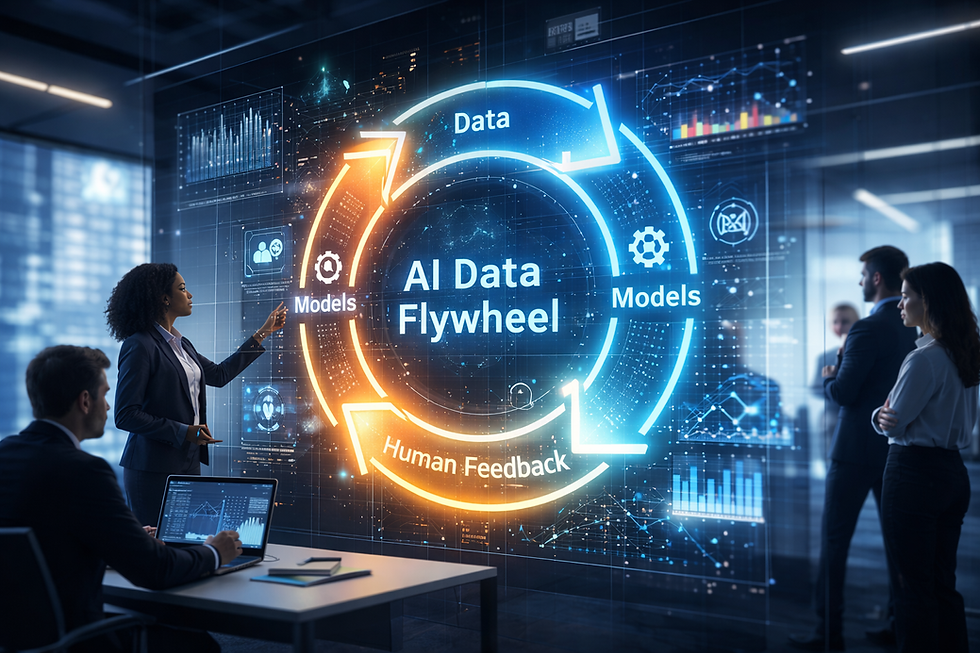
A practical blueprint for building an enterprise AI flywheel, turning everyday workflows into continuous learning systems
Most leaders will treat AI like software: procure a model, roll it out, and hope productivity rises. But the organizations that pull ahead will do something quieter and far more durable. They will build an AI data flywheel, a system that improves because it is used, captures judgment as signal, and compounds operational advantage with every cycle of real work.
The difference will not be who adopted AI first. It will be those who built momentum that others cannot easily replicate.
Executive Overview
An AI data flywheel is a self-improving loop in which usage generates data, data improves models, and improved models yield better outcomes that increase adoption and generate even richer signals.
The strongest enterprise AI flywheel is built on proprietary signals captured from real workflows—approvals, edits, overrides, escalations, and outcomes—rather than on generic datasets alone.
Human-in-the-loop AI is not a temporary training wheel; it is the mechanism that converts judgment into structured feedback, turning fragile automation into reliable, governed learning.
The flywheel’s advantage is compounding: it creates better decision quality, higher trust, broader deployment, and a widening lead that late adopters struggle to match.
AI initiatives stall when teams chase tools rather than design feedback capture, evaluation, and governance as first-class parts of the system.
The practical goal is not “more AI.” It is a continuous learning system that makes the organization measurably better at a defined job-to-be-done, month after month.
The Misunderstanding That Keeps AI Small
Many AI programs begin with optimism and end with a familiar disappointment: a clever pilot, a brief surge of excitement, and then a quiet return to old habits. The postmortem is usually framed as a model problem: accuracy, hallucinations, cost, latency. But in many cases, the real cause is simpler: the organization never built a learning loop.
Software adoption can succeed as a one-way transfer. You install, you train, you standardize. Learning is optional. But an LLM, especially one embedded in operations, behaves differently. If it does not learn from use, it becomes a brittle interface. If it does learn from use, it becomes a compounding asset.
That is what the AI data flywheel captures: not a technology choice, but a design choice. It is the difference between AI as an app and AI as an operating system for continuous improvement. Definitions vary across vendors and practitioners, but they converge on a common mechanism: a feedback loop in which data and outcomes reinforce each other over time.
What the AI Data Flywheel Actually Is
A practical definition is straightforward: an AI flywheel is a system in which real-world usage generates signals, those signals improve models and workflows, and those improvements increase usage, creating more and better signals.
It is tempting to imagine the model at the center. In practice, the model is only one component. The flywheel’s true center is the workflow, because it's where truth is produced: decisions are made, customers respond, cases close, money moves, and risk is accepted or avoided.
Most organizations already possess the raw materials of a flywheel. They have meetings, tickets, approvals, escalations, audits, sales calls, clinical notes, and customer success checklists. What they lack is a disciplined way to turn those activities into reusable learning.
The moment you capture judgment as data, what was accepted, what was rejected, and why it was changed, you have begun to build the wheel. And once you close the loop, feeding those signals back into evaluation, prompting, retrieval, fine-tuning, policy, or routing, you have begun to create momentum.
The Four Stages of a Durable Enterprise AI Flywheel
1) Instrumentation Before Automation
A flywheel cannot spin on guesses. It spins on measurement.
This is the stage most teams skip. They automate first, then scramble to understand failure. The more durable path is to instrument the workflow: capture inputs, capture decisions, capture edits, capture outcomes, capture exceptions. In human-in-the-loop systems, this is precisely how “bottlenecks” become “flywheels”, because the review step becomes an engine of learning rather than a cost center.
Instrumentation does not mean surveillance. It means defining what matters: the smallest set of signals that indicate whether the system is working. A sales team might track acceptance of drafted emails and the downstream reply rate. A legal team might track clause edits and the time-to-approve. A support team might track deflection and the quality of escalations. Without this layer, AI remains theatrical: impressive outputs with no durable improvement.
2) Feedback That Has Structure, Not Just Volume
Feedback is often treated as a thumbs-up button. That is not enough. A flywheel needs structured feedback: categories of failure, reasons for override, confidence ratings tied to a policy, and outcomes tied to real-world results.
Some of the most useful feedback is implicit. If a human rewrites a draft, the difference is signal. If a human routes a case elsewhere, the routing is signal. If a human ignores an AI suggestion, that is signal too, often the most honest kind.
Modern enterprise practice is increasingly explicit about the “AI generates, humans validate, feedback improves” loop because it produces sustainability rather than fragile speed.
3) Evaluation as a Living System
In a flywheel, evaluation is not a one-time benchmark. It is a living contract with reality. You are continually testing whether the system is still aligned with the environment it serves.
This is where many generative AI flywheel efforts quietly break. The organization cannot explain why quality improved or degraded. It cannot distinguish between model drift and data drift, or between prompt drift and workflow drift. So it reacts emotionally, either freezing deployment or expanding it recklessly.
The teams that win treat evaluation as product infrastructure: test sets, red-team cases, regression suites, monitoring for hallucination risk, and clear thresholds for when the human must remain in the loop.
4) Governance That Enables Scale
Governance is often framed as a barrier to momentum. But for an enterprise AI flywheel, governance is what makes momentum safe. It defines accountability, boundaries, review paths, data handling, and risk tiering.
In other words, governance prevents the flywheel from turning into a centrifuge, fast, impressive, and destructive.
This is why “meaning” keeps reappearing in serious enterprise conversations: AI must be tied to purpose, policy, and verification, not just capability.
Why the Flywheel Compounds When Others Plateau
The flywheel creates advantage through compounding, not novelty. Each cycle improves three assets at once:
Better outputs (quality and usefulness rise)
Better internal capability (teams learn what good looks like)
Better proprietary signals (your unique workflow data becomes defensible fuel)
This is the part that late adopters underestimate. They assume that if models are commoditized, the advantage disappears. But the flywheel’s advantage is not the base model. It is the system that turns day-to-day work into proprietary learning.
Practitioners describe this as a sustainable advantage built from “special fuel” - the data and signals that only your organization can generate at scale through use.
And in real enterprise deployments, we can clearly see the pattern: closed-loop improvement applied to production AI assistants and agents yields measurable gains in accuracy and latency when feedback is collected, analyzed, and acted on systematically.
Where the AI Data Flywheel Shows Up in the Real World
The flywheel is not confined to technology firms. In fact, its most dramatic impact often appears in domains historically constrained by human throughput and expert scarcity.
In healthcare, the flywheel emerges when clinicians validate summaries, correct coding, and refine triage, turning judgment into signal. In professional services, it appears that when partners edit drafts, adjust risk language, and approve recommendations, they create a reusable memory of how expertise behaves. In education, it shows up when learners struggle, ask questions, and receive adaptive practice, producing feedback that improves instruction over time.
This is why the flywheel is increasingly discussed as a dividing line in enterprise AI: leaders build self-reinforcing systems, while laggards remain stuck in disconnected pilots.
A Blueprint You Can Use: Build One Flywheel, Not Ten
The fastest way to stall is to attempt a dozen flywheels at once. A flywheel requires focus because it requires learning.
A pragmatic blueprint is to choose one workflow where:
Outcomes matter,
Humans already review work,
Feedback can be captured without disrupting operations.
Then design the loop intentionally:
Instrument the workflow.
Define structured feedback categories.
Build evaluation harnesses and monitoring.
Add governance rails.
Deploy, learn, iterate, and expand only then.
This method looks conservative on day one. But it is the path to compounding advantage because each iteration increases confidence, increases adoption, and generates the proprietary signals that fuel the next cycle. That is what AI-native products and systems are really doing when they appear to “move fast”: they are moving fast because their loop is intact.
The Leadership Question That Determines the Outcome
Not: “Which model should we pick?” Not: “How many copilots did we deploy?” But: “What will our organization be measurably better at in twelve months because our AI data flywheel existed?”
If you cannot answer that, you do not yet have a flywheel. You have activity.
If you can answer it, and you can point to the signals you will capture, the evaluations you will run, and the governance rails you will enforce, you are no longer “adopting AI.” You are building a compounding system that increases in value over time.
FAQs
Q: How long does it take to see flywheel effects? A: Initial value appears quickly, but compounding advantage typically emerges over 6–18 months of continuous use and feedback.
Q: Can small organizations build an AI flywheel? A: Yes. Smaller teams often move faster because feedback loops are tighter and intent is clearer.
Q: Does every AI system need a flywheel? A: No. But systems meant to deliver a durable advantage do. One-off automation does not compound.
Q: Where should humans stay in the loop? A: Wherever judgment, meaning, or accountability matters—which is usually closer to the decision than leaders expect.
Q: What breaks a flywheel fastest?
A: Removing feedback. Learning systems without learning are just brittle automation.



Comments